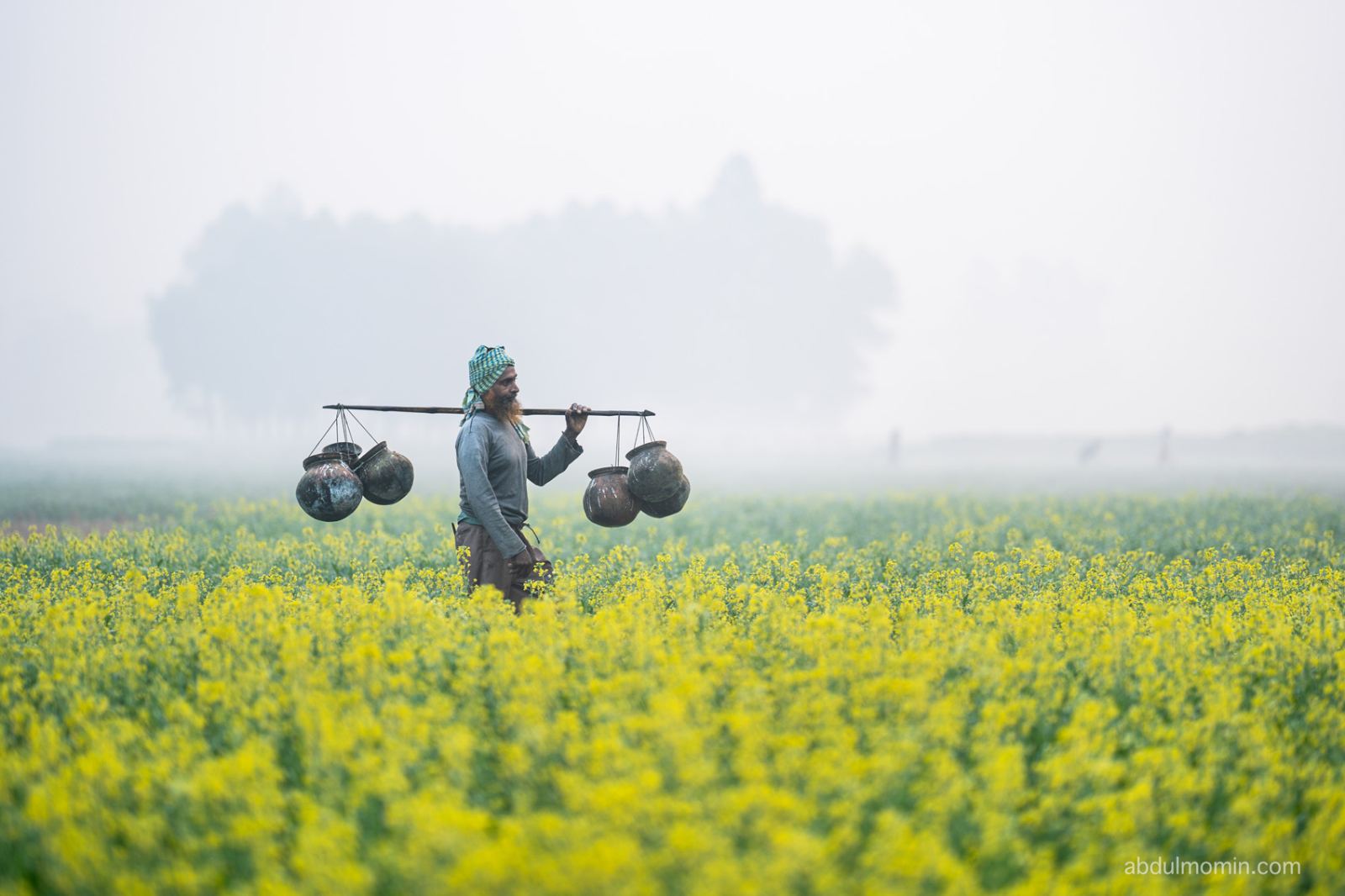
Every winter, as the fog rolls low over the paddy fields of northern Bangladesh, a quieter harvest begins. Before dawn, tappers climb wind-bent date palm trees with a curved knife, shave a fresh wound into the trunk, and hang a clay pot beneath it to catch the sap that drips out overnight. By sunrise they're climbing back down, one pot swinging from each end of a bamboo pole across their shoulders, walking home through mustard fields that have turned the whole horizon yellow.
This sap - khejur rosh in Bengali - is only harvestable for a few cold months a year, roughly December through February. Warm weather makes the trees stop producing it, which is part of why the whole tradition feels so tied to a specific, fleeting season. Photographers who come for it are really coming for two things happening at once: the sap harvest itself, and the particular quality of light that only shows up in a North Bengal winter - thick mist that burns off slowly, backlighting figures long after sunrise elsewhere would have gone flat.
Some of the sap is sold straight, still faintly sweet and cloudy. Most of it gets boiled down the same day in huge, blackened pans over wood fires, reducing for hours until it thickens into gur - a raw, deeply flavored jaggery that shows up in winter sweets across Bengal. The boil-down yards themselves are a scene worth planning around - firelight, steam, and the rhythm of someone stirring a pan that's nearly as wide as they are tall.
A few things worth knowing if you're planning to shoot this:
The best hours are early. Tappers are usually out collecting before 7am, and the mist that makes North Bengal's winter light so distinctive tends to burn off within a couple of hours of sunrise. This is not a tradition that waits for a relaxed late-morning start.
It's genuinely cold before sunrise, colder than most visitors expect from Bangladesh. Layers help, and so does patience - a lot of the best frames come from waiting at one tree or one boil-down pan rather than chasing several locations in one morning.
The people doing this work are often the same families, year after year, and many are happy to explain the process if you're not just pointing a camera and leaving. Some of our best mornings on this route have come from sitting with a tapper over the first boiled-down batch of the day.
We build this into the itinerary on our Experience Winter Life in North Bengal tour, and it also appears as a stop on several of our other winter-season itineraries that pass through the same region. If you're building a Bangladesh trip specifically around this window, December and January are the safest bet - by late February the season is already winding down.
See more of Momin's work at abdulmomin.com, or read more travel stories on TraveloJoy.